

sales@zjlinkwin.com

Mobile
+86 15706104016



sales@zjlinkwin.com
Mobile
+86 15706104016
_1786502726_WNo_1000d563.webp)
With the rapid development of greenhouse farming, commercial nurseries, urban agriculture, and large-scale crop production, the demand for efficient and reliable seedling trays is increasing worldwide. Seedling trays are no longer only simple planting containers; they have become an important tool for improving germination rates, optimizing space utilization, reducing labor costs, and supporting standardized plant production.
However, many growers and agricultural suppliers face challenges when selecting the right seedling tray. Different crops, growing environments, and production goals require different tray structures, cell sizes, and materials. Choosing an unsuitable seedling tray may lead to poor root development, inefficient transplanting, higher material costs, or reduced production efficiency.
This guide will introduce the main types of seedling trays, including plastic nursery trays, plug trays, propagation trays, biodegradable trays, and different material options. By comparing their structures, materials, advantages, limitations, and applications, this article will help growers, greenhouse operators, and agricultural buyers understand which seedling tray is the best choice for different planting requirements.
Seedling trays are specialized containers designed for seed germination and early-stage plant growth. They are widely used in vegetable cultivation, flower production, greenhouse farming, forestry planting, and commercial nurseries.
Unlike traditional direct sowing methods, seedling trays provide individual growing spaces for plants, allowing better control of moisture, root development, and transplanting processes. Common seedling trays include multi-cell plug trays, flat trays, propagation trays, and biodegradable nursery trays. Different cell numbers and tray depths are selected according to crop type and growth requirements. :contentReference[oaicite:0]{index=0}
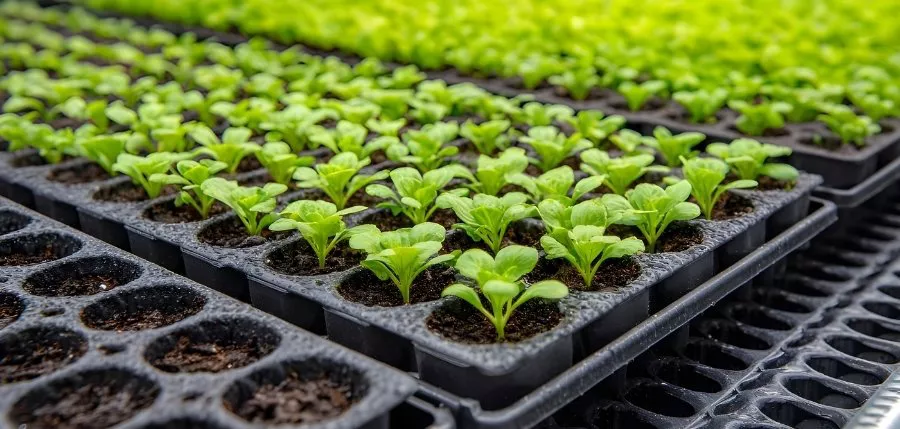
Plastic plug seedling trays are one of the most commonly used types of seedling trays in commercial agriculture and greenhouse production. These trays are designed with multiple individual cells, allowing each seedling to grow separately during the early development stage.
They are commonly manufactured using plastic materials such as polypropylene (PP), polystyrene (PS), and recycled plastics. Depending on crop requirements and production methods, plastic plug trays are available in different cell numbers, including 32-cell, 50-cell, 72-cell, 128-cell, and 200-cell designs.
Plastic plug seedling trays are widely used for vegetable seedlings, flower cultivation, greenhouse planting, and commercial nursery production. They are suitable for crops that require standardized seedling growth and efficient transplanting management.
Flat seedling trays are shallow planting containers commonly used for seed germination, early-stage plant growth, and nursery propagation. Unlike plug trays with individual cells, flat trays usually provide an open growing area where multiple seedlings can develop together.
These trays are generally produced from durable plastic materials and are commonly available in standard sizes such as 1020 trays and similar formats. Their simple structure makes them widely used in seed starting, microgreen cultivation, and small-scale plant propagation.
Flat seedling trays are commonly selected by growers who need flexible planting spaces for germination and early plant development before transplanting.
Deep cell seedling trays are designed with deeper individual cells to provide more growing space for plant roots during the nursery stage. Compared with standard cell trays, they are mainly used for crops that require longer growth periods or stronger root development before transplantation.
These trays are usually made from rigid plastic materials and are available in different cell depths and sizes according to crop requirements. They are commonly used for vegetable seedlings, flowers, forestry seedlings, and plants with larger root systems.
Deep cell seedling trays are widely applied in professional nurseries where root development and seedling quality are important factors during cultivation.
Biodegradable seedling trays are an environmentally focused alternative designed for growers who prefer renewable and sustainable planting materials. These trays are commonly produced using materials such as peat, coconut coir, paper fiber, and other biodegradable plant-based materials.
They are mainly used in organic farming, sustainable agriculture projects, and short-cycle crop production. Biodegradable seedling trays are suitable for applications where growers want to reduce dependence on traditional plastic planting products.
These trays are commonly used for vegetable seedlings, flowers, and other crops that are suitable for environmentally friendly nursery production methods.
| Seedling Tray Type | Main Material | Common Sizes | Applications | Advantages | Limitations |
|---|---|---|---|---|---|
| Plastic Plug Seedling Tray | PP, PS, PET plastic | 32, 50, 72, 128, 200 cells | Vegetables, flowers, greenhouse seedlings | Reusable, durable, good drainage, suitable for automated nursery production | Requires cleaning and recycling management |
| Flat Seedling Tray | Heavy-duty plastic | 1020 tray and similar sizes | Seed germination, microgreens, early plant growth | Low cost, easy handling, suitable for large quantities | Less root separation compared with cell trays |
| Deep Cell Seedling Tray | Rigid plastic | Large volume cells | Crops requiring stronger root systems, vegetables with longer nursery periods | Provides more space for root growth and reduces transplant stress | Higher material consumption and cost |
| Biodegradable Seedling Tray | Peat, coconut coir, paper fiber, biodegradable materials | Small and medium cell trays | Organic farming, environmentally focused agriculture | Can reduce plastic waste and may allow direct transplanting | Lower durability and shorter service life compared with plastic trays |
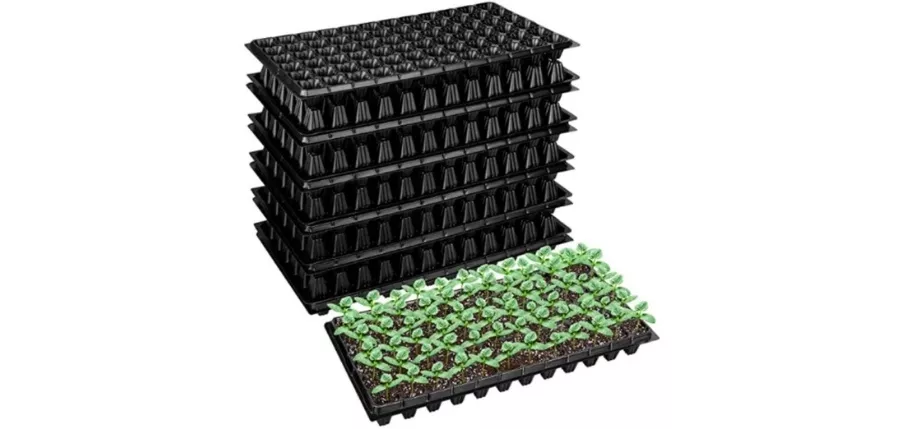
Choosing the right seedling tray depends on your crop type, growing environment, production scale, and cultivation goals. Different seedling trays are designed for different planting requirements, so growers should first identify their production challenges and then select a tray structure that can improve seedling quality and production efficiency.
For commercial nurseries, greenhouse farms, and large-scale vegetable production, plastic plug seedling trays are one of the most commonly used options. Their multiple-cell design helps growers produce a large number of seedlings in a limited space while maintaining consistent growing conditions.
They are suitable for crops such as tomatoes, peppers, cucumbers, lettuce, and other vegetables that require standardized growth, easy transplanting, and efficient nursery management.
If seedlings need a longer nursery period or often experience weak root growth and transplant stress, deep cell seedling trays can provide more space for root expansion.
They are suitable for crops with larger root systems, longer growth cycles, and plants that require stronger root structures before moving to fields or larger containers.
For growers who want to maximize seedling production within limited space, high-cell seedling trays are a practical solution. Their compact cell design allows more plants to be cultivated per tray and improves space utilization.
They are commonly used for small vegetables, leafy greens, herbs, flowers, and other crops that can be transplanted at an early growth stage.
For flower growers, greenhouse operators, and plant propagation businesses, propagation trays are designed to provide uniform growing conditions for young plants.
They are suitable for flowers, ornamental plants, herbs, and nursery seedlings that require consistent cell sizes, good drainage, and controlled early-stage growth.
For growers who focus on sustainable agriculture, organic farming, or reducing plastic consumption, biodegradable seedling trays can be an alternative option.
Made from materials such as peat, coconut fiber, or paper-based materials, these trays are suitable for short-cycle crops and planting projects where biodegradable materials are an important consideration.
For professional nurseries that operate throughout the year, reusable PP seedling trays are a reliable choice. Their durable structure allows them to withstand repeated handling, cleaning, transportation, and multiple production cycles.
They are suitable for commercial growers who focus on reducing replacement costs and maintaining stable nursery operations over the long term.
If your production process requires efficient transplanting and better protection of young roots, plug seedling trays can help maintain individual root systems during the nursery stage.
They are widely used for vegetables, flowers, and nursery plants where reducing transplant damage and improving plant survival rates are important goals.
Selecting the right seedling tray requires careful consideration of crop type, growing environment, nursery scale, tray structure, and material requirements. Different applications require different solutions. Plastic plug seedling trays are commonly used for commercial nurseries that need efficient production and consistent seedling quality, while biodegradable trays can be considered for growers focusing on sustainable agriculture.
For growers and agricultural suppliers, choosing the correct seedling tray is not only about the tray size or material, but also about whether it can meet long-term planting requirements, improve nursery efficiency, and support stable plant growth. Understanding your crop characteristics and production goals can help you avoid unsuitable tray selections and achieve better cultivation results.
If you are looking for suitable seedling trays for vegetable cultivation, greenhouse production, or commercial nursery applications, Linkwin can provide professional recommendations based on your planting requirements and application needs. Contact our team to explore suitable seedling tray solutions and get more information for your agricultural production.




We use cookies to make the website work, to provide advanced features, social media and traffic analysis, and we use analytics and third-party advertising cookies. If you choose to click "Deny All", you will retain the default setting of not allowing the use of cookies or other tracking tools other than technical tools.




.png)

.png)



.png)